Japanomie
Singlehood norms are changing fast, can our theory account for that?

I ended my last post talking about how, despite its frustrations, I really enjoy working in multidisciplinary spaces. It would be easy to frame this as some kind of moral virtue, but the fact is that, as someone who scores near the top of the scale in openness to experience, it’s a predilection I carry with me for better and worse.
Translation issues across disciplines
Working in multidisciplinary spaces can be awkward. This kind of work goes beyond things like borrowing research tools from other disciplines, and frequently brings into conflict deeply held and even unconscious assumptions and values. I think this is why, despite the universal esteem in which the idea of multidisciplinary approaches is held, that people rarely actually do this kind of work. It is far less destabilizing to spend time sharing your ideas with people who basically already agree with you than risk sharing your ideas with people who might quietly think that you have a moral screw loose for thinking the way that you do.
Part of the problem is that when you walk into someone else’s disciplinary space, the ideas are rarely just the ideas themselves but are attached to all kinds of political and historical baggage that are invisible for you. If you rock up at a social psychology conference wanting to discuss results in light of, say, Freudian perspectives, you run a good chance of being seen as something between ignorant and practicing witchcraft.
In fact, our relationships research group experienced something like this having invited someone from our English department to speak about her work on romance. She opened the talk by referencing Lacan, and upon seeing the blank looks on our faces, paused to ask us if we knew who Lacan was. We did not. When we learned that Lacan was a psychoanalytic thinker, our looks changed from puzzled to confused and disappointed. Of course, upon learning that people in her university’s psychology department didn’t know what to her mind was one of history’s most prominent psychologists, she returned the look in kind. Having gone on to learn about Lacan that day, I will say that he may be the only thinker I know of who, both among those love his work and those who do not, see his work as lacking (that is a Lacanian dad joke).
Akiko Yoshida and Japanese singlehood
So it is in this spirit and with these disclaimers that I wander slightly afraid into writing ths post. You see, there is a paper in singlehood studies that I really love but that I see getting almost no attention, and I want to highlight it with this post. The paper comes from sociology and invokes the work of a thinker that I have reason to believe might carry a certain kind of baggage, Émile Durkheim. The paper is not written by Durkheim himself, but by the now retired Dr. Akiko Yoshida. It’s titled Anomie, gender, and inequality: Developing sociological theory of singlehood from Japanese experiences.
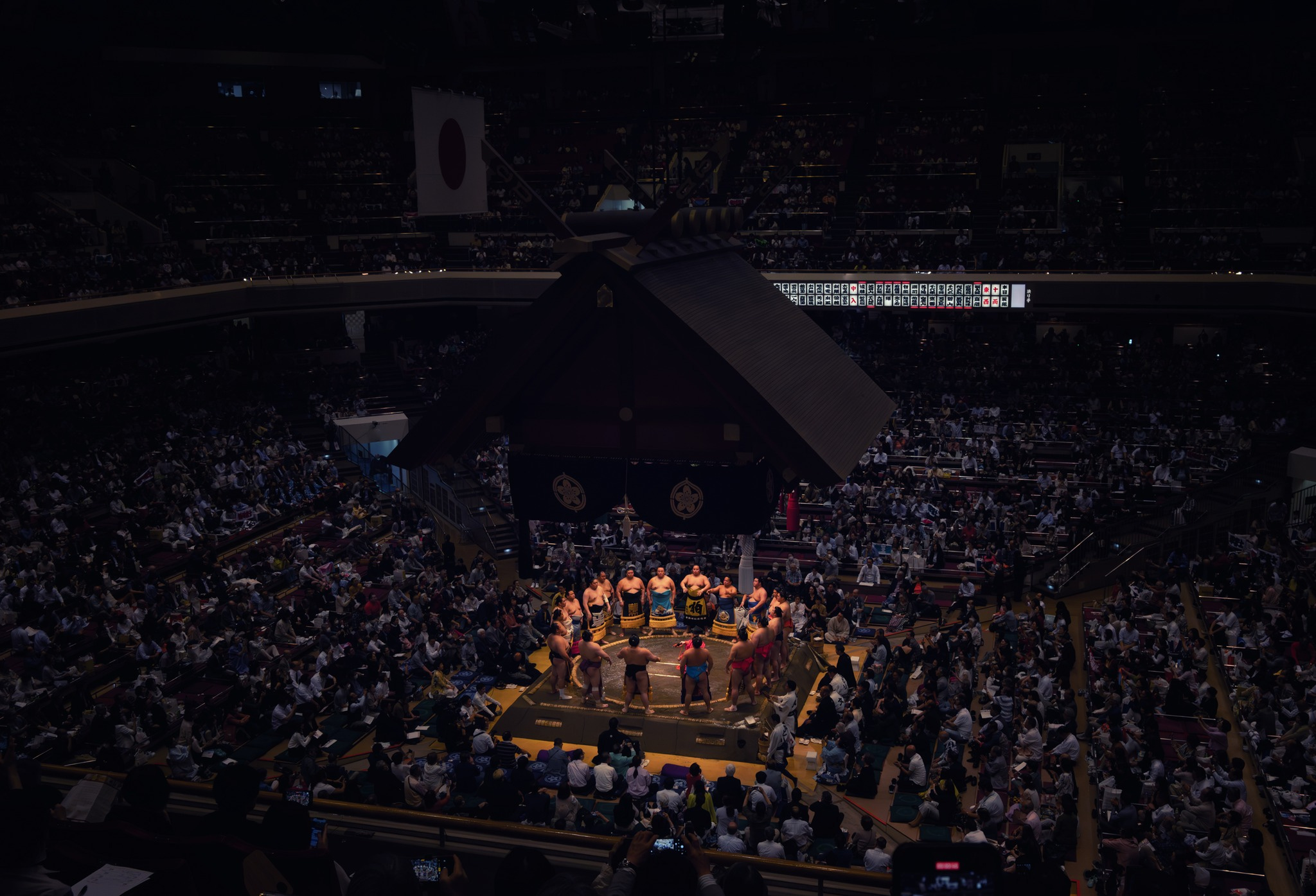
The Ryōgoku Kokugikan in Tokyo. No shortage of tradition here.
I had the good fortune of meeting Dr. Yoshida once, online. I was such a fanboy of her paper that I invited her to speak to us at one of our lab meetings. Because she was already retired at that point, it took a little back and forth, but in the end she pulled an Elvis and came out of retirement to talk to us about her work. We were not disappointed – even having been out of the game for a while she was smart, integrative, and a definite live wire.
Durkheim and anomie
There are two central points in Dr. Yoshida’s paper that I really glommed onto, and that I think have important relevance to singlehood studies today. The first part is her invocation of Durkheim, particularly the concept of anomie. In the paper, Dr. Yoshida defines anomie as follows:
Anomie refers to a state of society, caused by rapid social change, in which (traditional) culture is weakened or absent and thus no longer prescribes appropriate behaviors for individuals.
And this is where, as someone who really doesn’t know anything about sociology nor whatever baggage Durkheim carries with him, I need to say that this is so obviously an important piece of what is happening around singlehood right now. This is an era where we have to ask whether or not it’s embarrassing to have a boyfriend because nobody seems to know for sure. I can’t say I have a sophisticated handle on the full idea of anomie, but I am struck by the fact that despite seeming so obviously relevant, outside of Dr. Yoshida’s work I do not think I have seen anomie discussed in the singlehood literature. I’m not sure what to make of that.
What I infer from Dr. Yoshida’s paper is that she believes the reason a concept like anomie has not been strongly integrated in singlehood thinking is that the concept comes from a perspective that social change is not always necessarily good. Anomie also seems to come tied to the idea that norms themselves are not always constraining and oppressive, but are at times helpful in structuring and guiding individual behaviour. In an age when too many people are flirting with fascism, I can see why this part in particular could raise tension.
At the same time, I think about the question I always get asked by new graduate students, “How many papers do I need to get a job?”. I always want to provide a normless answer, that focusing on the work itself is what’s important, that chasing knowledge and understanding for their own sake will be what will fuel the success you need to get where you want. But my students are never soothed by that. They want a number. And in the end, I give it to them.
In terms of singlehood, none of this is necessarily to say that the old, clearer norms were good, or at least certainly not good for everyone. My suspicion is that single men might resonate more with the idea of singlehood anomie than single women, for example. But as someone who does a lot of descriptive work, who wants to understand single people without judgement (negative or positive), I just see a ton of potential descriptive value in application of this idea of anomie.
Western bias in singlehood research
The other set of ideas in this paper that I think is very important to talk about is the way that Dr. Yoshida identifies theorizing in singlehood studies as highly Western. She is not the only scholar I have seen raise the point, and there is in fact a singlehood conference happening around this theme this summer. Dr. Yoshida describes Western thinking about singlehood as centered around choice, and centered around the idea that changes in rates of marriage are happening as a result of individual choices. Indeed, autonomy is a highly prized value in the West, so it is not surprising to see Western theorizing centered around this value.
The way this argument unfolds in Dr. Yoshida’s paper, in my reading, centres on this quote.
Through all these changes, the great majority of Japanese continue to desire marriage.
The argument, then, is that increases in rates of singlehood may have come not from the desires of the majority of single people but against the desires of the majority of single people. If you don’t assume large scale social change results from autonomous choices, you leave the door open to the idea that the changes that are happening reflect forces working against, or at least orthogonal to, majority will (I suspect work on the introduction of AI to society would benefit from consideration of anomie for similar reasons).
In the East Asian context in particular, this makes sense to me. As was highlighted by the paper I discussed a few posts ago, the Confucian values running through many East Asian societies result in strong internalization of values centred on family and tradition. In that light, it is not surprising that marriage is something that has important personal value to people in these cultures, and that the erosion of norms around marriage can be both confusing and upsetting alongside elements of liberation.
All up, I just find this paper by Dr. Yoshida to be extremely refreshing and stimulating. I’m too unfamiliar with sociology to really know its ultimate value, but I know it presents a well-thought through perspective that shows singlehood in a different light than I’ve seen it discussed anywhere else. I have a sweet tooth for that kind of iconoclastic perspective (see experience, openness to). I hope you give it a read, I think it will be worth your time.