What's It Like Being Interviewed?
Reflections on dealing with the media

As I write this, it’s the Family Day holiday here in Ontario. When I was single, I used to think of this weekend as the Ontario One-Two Punch, with Family Day swiftly following Valentine’s Day. As a relationship researcher, Valentine’s Day is traditionally the one time of year when media takes an active interest in our work. It is, to be honest, a little insulting that certain parts of the media think of relationships as a sort of side-show curiosity to be trotted out once a year as part of a corporate push to sell greeting cards and roses. When you understand how central relationships are to human motivation and even the evolution of humanity itself, these annual pats on the head can feel miscalibrated and diminishing.
The blooming of academics in media
In fairness, singlehood and relationships have been increasingly breaking out of the Valentine’s Day media asylum in the past few years. It’s been a strange thing having been in this business for 30 or so years now to see academic psychology in general go from being completely off the media radar to being semi-ubiquitous. This thawing out goes both ways; when I was a grad student, there was a sort of purity culture in academics and it was considered mildly debasing to speak to the media.
In fact, we probably can’t fully understand the replication crisis without factoring in the way that media attention (and the lucrative public intellectual space it created) changed the incentive structure. When people would get caught committing data fraud when I was in grad school, it always seemed an odd choice since the upside was so limited. I remember an early data faking scandal that happened when I was a grad student in the pre-media era, after which a colleague uttered the classic line, “If you’re going to fake data, at least fake interesting data.” Whatever else academic psychology has done, the new media incentive structure means we can certainly say that the field has improved exponentially on this front.
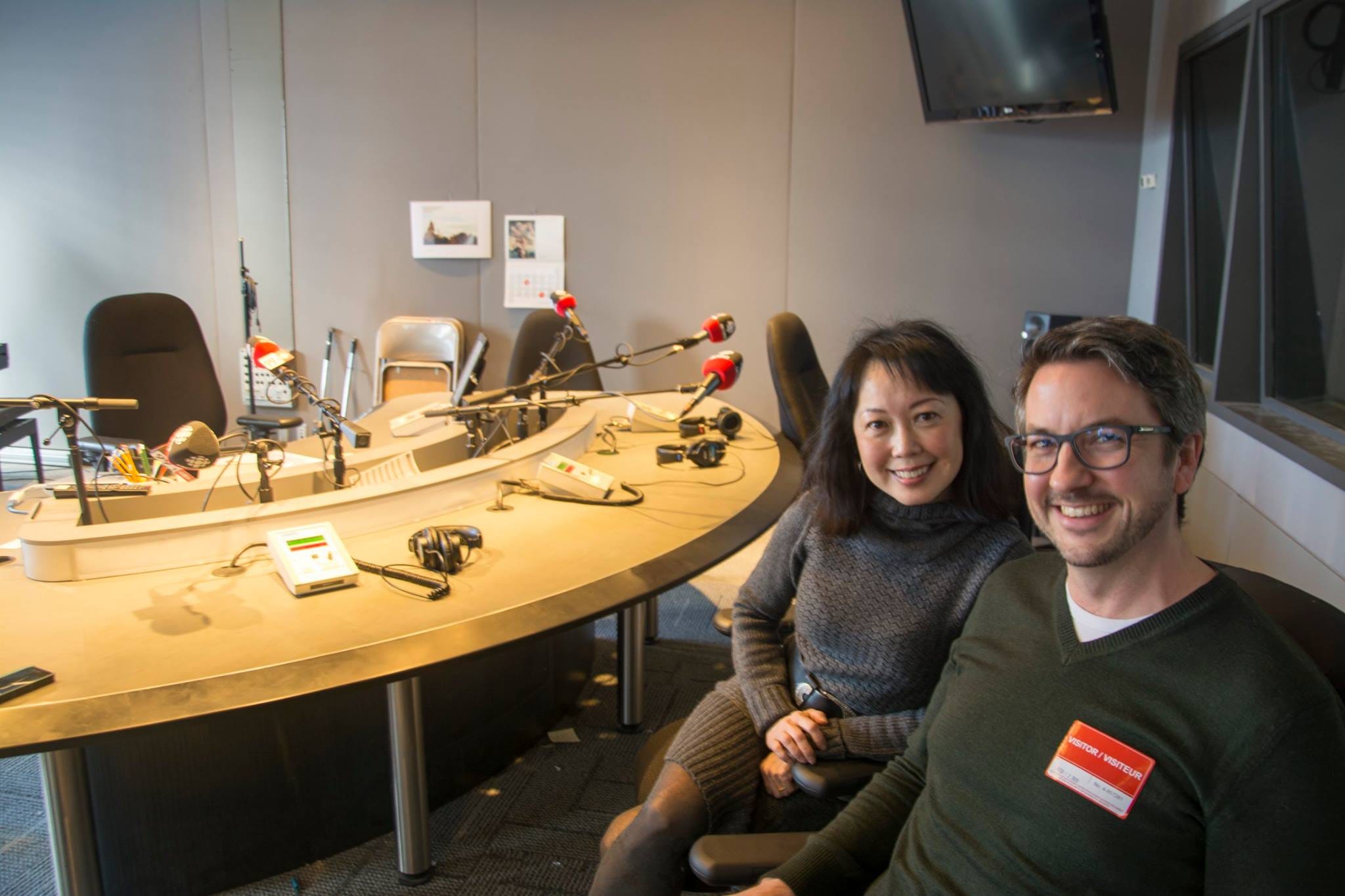
A younger version of me with Mary Ito at CBC studios
Like many people in my field, the increased interest of media in our work has allowed me multiple opportunities to experience being interviewed and seeing that raw material processed into news and opinion pieces (you can find many of them here on the MacLab media page). I’ve always been interested in the process; I did a little work in radio back in the day, and sometimes imagine an alternative self who did his degree in communication instead of psychology. As such, I know there are fields that study these things in systematic ways, so I would assume there’s nothing particularly new in the reflections I’ll share here. But I think that since more and more information about our work is being absorbed through these kinds of media channels, it’s worth talking about the whole thing from a “there’s many a slip between the cup and the lip” perspective.
The benefits
First, I do think the attention that media pays to our work is a net plus overall. At least here in Canada our work is funded by taxpayers, so I don’t think it’s right to hide what the taxpayers paid for in walled-off journals and for-profit books. Those things have their place, but if we’re not giving at least some of our work away for free, then we’re not really honouring the people who pay for us to live the lives that we do.
I’ve also been convinced that even if your primary goal is to spread your work only in academic circles, that media attention is an important component. As I mentioned in an earlier post, research has shown that academic papers that get media attention also get more citations. I resonate with this personally, I can think of a lot of papers that I came across not because of conferences or journals but because a media story happened to come up in my feed.
We’ve also found this true in our own lab. A MacLab paper first-authored by my grad student Elaine Hoan on women being happier in singlehood than men ended up being a minor media sensation. We were caught off guard by this; primarily, we wrote the paper because there was a general sense in the literature that women were happier being single, but it hadn’t been documented conclusively. So we wrote the paper with an academic audience in mind. But after the media picked up on the work, our paper ended up as the most read article at Social Psychological and Personality Science, with over 40,000 views and downloads as of this writing.
What are journalists trying to do exactly?
I’ve been asked a few times why that paper in particular was something media were attracted to, and I think it’s an interesting question to contemplate. I’m sure there’s lots of reasons (nothing has just one cause), but there’s one reason in particular I think is important for both journalists and academics to keep in mind. In academics, we work in the knowledge economy, where truth is (ideally) the most important currency. But in media, they work in the attention economy, where novelty and surprise are among the most important currencies.
My sense is that media loves a story with the structure, “You think it’s X, but it’s actually Y” (in this case, “You think women love relationships, but they actually love singlehood”). The surprise this generates makes for a great headline, or even better these days, a controversial conclusion that sparks social media fighting. There’s nothing inherently wrong with this approach, per se. But for an academic invested in communicating truth, there are pitfalls in trying to traverse this landscape.
How well do relationship truths fit the media landscape?
For one, I think a lot of the most important parts of singlehood and relationships are not that surprising. It doesn’t make for a particularly catchy headline to say, “It would help a lot to learn to manage your emotions,” or “Learn your romantic partner’s needs.” This is the sort of bread-and-butter, grandfatherly wisdom that is going to shock no one, but is going to make your life better in deeply meaningful ways if you take it seriously. The trick is not learning that things like this are true, but in implementing these lessons consistently in the day-to-day slog of life when it’s so easy to do otherwise.
From an academia-media interface perspective, the problem is that those sort of boring, deep truths are not the kind of information a media interview tends to pull for. I frequently get asked questions like, “What’s the newest research?” or “What surprised you most about your findings?”. I always feel like these are questions from journalists who may not have totally done their homework on the topic at hand and who want a nice unit of surprise to plug into their story. But wisdom is not a game of peek-a-boo.
Losing control of the narrative
There’s also the issue of accuracy. I think most academics who have done media have had the experience of having their thoughts selectively quoted, or of having points they know are crucial ignored. You’re then left with the discomfort of lending your credibility as an academic to something you think is wrong or even potentially harmful. As I discussed in a previous post, once a piece of misinformation gets out of the barn, it’s basically impossible to get back in.
And I do wonder how much journalists think about this; what for them is a one-off piece before they move on to the next assignment can be a lifetime of professional burden for us academics. In fairness, journalists seem to be to be overworked, underpaid, and usually working under precarious circumstances. But when they do create messes, it’s often those of us in the fields they cover who are left to deal with the aftermath.
How do you decide what interview to take?
Of course, this experience isn’t universal and after a while you start to develop a sixth sense about what interviews to take. I actually turned this into an assignment for my undergraduate relationships class. The students’ job is to look up a media article about a research study, and then go read the research study itself with the goal of identifying cues of trustworthiness. Although the students probably won’t be doing a ton of interviews themselves, I figure once they leave university, they will get most of their information about singlehood and relationship research through the media, so it’s good to leave them with a sense of the way in which these stories are sometimes good and are sometimes oddly skewed echoes of what the work was meant to convey.
There’s also the part where, as in any field, some journalists are just better than others. I’ve had great experiences, for example, with people like Mary Ito, Eric Dolan, and Faith Hill. Mary Ito in particular left such a strong impression on me. She asked me questions about my work in one interview that were sharper than the ones I’d gotten during the review process that paper had just gone through with professional editors and reviewers. I’m a big fan.
But the format matters too. I am definitely more hesitant to accept interviews for print publications than for things like long-format audio reports. In print, most of the narrative is the writer speaking to the audience, with expert quotes sprinkled in like pieces of flair. Something I think most of us who have done interviews have experienced is a journalist who already knows what they want the story to be, and who asks questions to try to pull quotes that will support that story (journalistic p hacking). In long-format audio, most of the story is the expert’s own words, and I usually listen to those pieces more satisfied that my perspective has been accurately conveyed. Basically, if the plan is to make me look like an idiot, let me do it myself.
Dealing with journalists is another interdisciplinary adventure
The new media landscape is weird space for an academic to operate in, but I think all up I like engaging with it for the same reason I like doing multidisciplinary work in general. Journalists just see the world from a different perspective than academics do – as a rule I find them to be smart and curious, but not as burrowed into just one topic as us academics are. But their incentive structure is different from ours, and I think being mindful of that is important for making sure we can further our academic goals in media spaces.